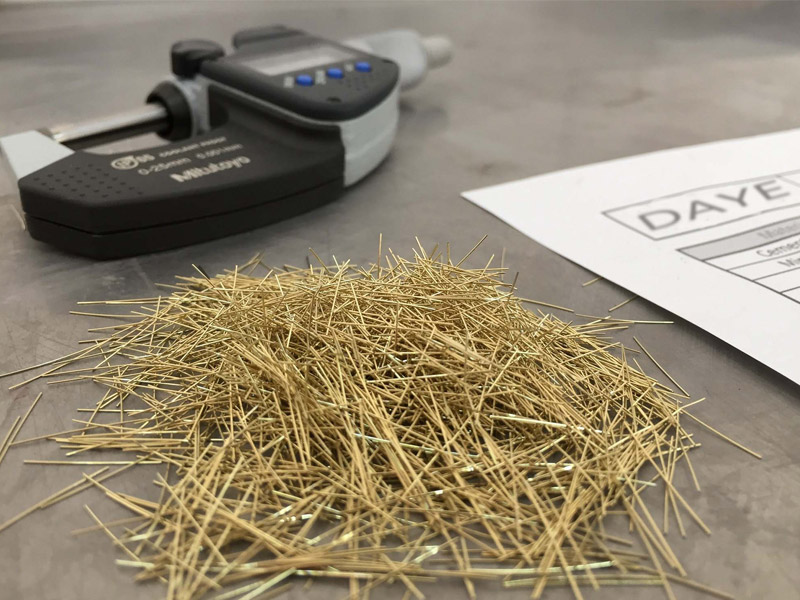
Choosing the right steel fiber for concrete can determine whether a floor, tunnel, bridge deck, or precast element performs well for decades—or develops cracks and durability problems soon after construction. Many buyers ask the same question in different ways: What are the standard types? What do shape names like hooked-end, crimped, or straight mean? How do you match a fiber to a real project?
This guide answers those questions in plain language. It is written for engineers, contractors, specifiers, and procurement teams who need a practical framework rather than a textbook full of formulas.
Key Takeaways
Steel fiber types can be classified two ways: by manufacturing method (ASTM A820 / EN 14889-1) and by market shape (straight, hooked-end, crimped, flat-end, twisted, and other deformed forms).
Cold-drawn wire fiber is one of the most common categories and is widely used in precast, slabs, and shotcrete.
Hooked-end fiber is popular because the end deformation improves anchorage and pull-out resistance compared with plain straight fiber.
Shape, length, diameter, aspect ratio, tensile strength, coating, and dosage must all match the concrete mix and structural requirement.
Always request the supplier's product data, applicable standard compliance documents, and—where the design requires it—trial mix results before finalizing a specification.
Why Steel Fiber Types Matter in Concrete
Steel fiber reinforced concrete uses short steel filaments randomly distributed throughout the mix. When a crack starts to open, fibers bridging the crack help resist further opening. This can improve toughness, impact resistance, fatigue performance, and durability.
But not every fiber behaves the same way. The manufacturing method influences the material and consistency, while the fiber shape influences how the fiber anchors in the concrete matrix. That is why both the standard classification and the commercial shape names matter.
Steel Fiber Types by Manufacturing Method
Global specifications often reference ASTM A820/A820M or EN 14889-1. These standards classify steel fiber mainly by how it is produced.
The same standard also permits fibers to be straight or deformed. In everyday purchasing, suppliers often describe products by shape because contractors can visualize how the fiber will perform.
Steel Fiber Types by Shape
Market shape is usually the fastest way for engineers and installers to narrow down options.
Straight Steel Fiber
Straight steel fiber has no hook, wave, or twist. It mainly relies on bond and friction with the cement matrix.
Best for: General crack control, shotcrete, and precast elements where higher fiber dosages might affect workability.
Hooked-End Steel Fiber
Hooked-end steel fiber is one of the most recognized commercial shapes. The bent ends provide mechanical anchorage inside the concrete and improve pull-out resistance compared with a plain straight fiber of similar size.
Best for: Industrial floors, precast products, tunnel linings, bridge decks, and structural fiber-reinforced concrete.
Crimped or Wavy Steel Fiber
Crimped steel fiber has a wavy or corrugated body. The undulating shape increases surface contact and improves mechanical interlocking along the fiber length.
Best for: Pavements, overlays, precast tunnel segments, and structures subject to fatigue or thermal cycling.
Flat-End or Enlarged-End Steel Fiber
Flat-end steel fiber stays mostly straight but has enlarged or flattened ends to improve anchorage.
Best for: Applications where the designer wants a straighter fiber profile with better end anchorage than plain straight fiber.
Twisted Steel Fiber
Twisted steel fiber has a distinct helical geometry. The twist changes bond and pull-out behavior compared with straight or hooked fibers.
Best for: Advanced fiber-reinforced concrete systems where stronger mechanical interlock and higher post-crack contribution are required.
How to Match Steel Fiber to Your Project
Two fibers can both be called "hooked-end steel fiber" and still perform differently because of length, diameter, aspect ratio, tensile strength, coating, and dosage.
Application | Common Shape | Length × Diameter | Tensile Strength | Typical Dosage |
|---|
Light crack control | Straight or hooked | 13 mm × 0.2 mm | Project-specific | Project-specific |
Industrial floors | Hooked-end | 13 mm × 0.2 mm | Project-specific | Project-specific |
Tunnel shotcrete | Straight or hooked | 13 mm × 0.2 mm | Project-specific | Project-specific |
Bridge decks | Hooked-end | 13 mm × 0.2 mm | Project-specific | Project-specific |
UHPC elements | Hooked-end or micro copper-coated | 6–13 mm × 0.12–0.2 mm | Project-specific | Project-specific |
High-speed railway / RPC | Micro copper-coated | 6–13 mm × 0.12–0.2 mm | Project-specific | Project-specific |
The table above is a starting point. Final dosage and performance must be confirmed through design calculations, supplier data, and trial mixes.
Key Selection Parameters
When evaluating steel fiber products, do not compare only by shape name or unit price. Check the following:
Length and diameter: These affect crack bridging, surface area, balling risk, and workability.
Aspect ratio: EN 14889-1 lists a common range of 30–100 for aspect ratio, while traditional steel FRC references often show 30–80. Higher aspect ratios can improve crack bridging but may also increase balling risk.
Tensile strength: Minimum average tensile strength in ASTM A820 is 345 MPa, but high-performance products may have much higher values.
Surface coating: Copper or brass coating can improve corrosion resistance and interfacial bond.
Standards compliance: Verify the product meets the requirements cited in the project specification, such as ASTM A820, EN 14889-1, or local standards.
Dispersion method: Glued or row-bonded fibers can help improve dosing and dispersion in some applications.
FAQ: Common Questions About Steel Fiber Types
Q1: What are the different types of steel fiber for concrete?
Steel fiber is classified by manufacturing method (cold-drawn wire, cut sheet, melt-extracted, mill-cut or shaved cold-drawn wire, and modified cold-drawn wire or milled-from-block) and by shape (straight, hooked-end, crimped, flat-end, twisted).
Q2: Which steel fiber type is most common?
Cold-drawn wire fiber is one of the most common categories. It is often supplied as hooked-end or straight fiber for precast, slabs, and shotcrete.
Q3: Is hooked-end steel fiber better than straight steel fiber?
Hooked-end fiber generally provides better mechanical anchorage and pull-out resistance. Straight fiber can still be appropriate for early-age crack control and specific shotcrete or precast applications.
Q4: Can steel fiber replace rebar?
In some designs, steel fiber can reduce or partially replace secondary mesh. It cannot automatically replace all structural reinforcement; the decision must follow the project design and applicable test data.
Q5: Does higher tensile strength always mean better performance?
No. Strength is only one parameter. Length, diameter, aspect ratio, shape, dosage, concrete mix design, and placement method all influence the final result.
Q6: How do I avoid fiber balling during mixing?
Use proper mixing procedures, add fibers at the right stage, and consider glued or row-bonded formats for some applications. Always conduct a trial mix for critical projects.
Choose Daye as Your Steel Fiber Manufacturer
Selecting the right steel fiber is not about memorizing every product name—it is about matching manufacturing type, shape, dimensions, tensile strength, coating, and dosage to your concrete application.
Daye has been manufacturing steel fiber since 2002 and offers a wide product range, including straight steel fiber, hooked-end steel fiber, wavy steel fiber, stainless steel fiber, glued steel fiber, and micro steel fiber for UHPC systems. Daye's product range is backed by practical manufacturing experience and international export knowledge.
When you work with Daye, you get more than a product list. You get technical support for specification, mixing guidance, and export experience across global markets. Whether your project involves industrial floors, tunnels, bridges, precast elements, or ultra-high-performance concrete, Daye can help you choose the right steel fiber type with confidence.
Contact Daye today to discuss your project requirements, request product data, or arrange samples.





 Aug 11, 2026|
 View:230