


Why UHPC & Decorative Concrete Need Micro Steel Fiber
 Oct 20, 2026|
 View:6
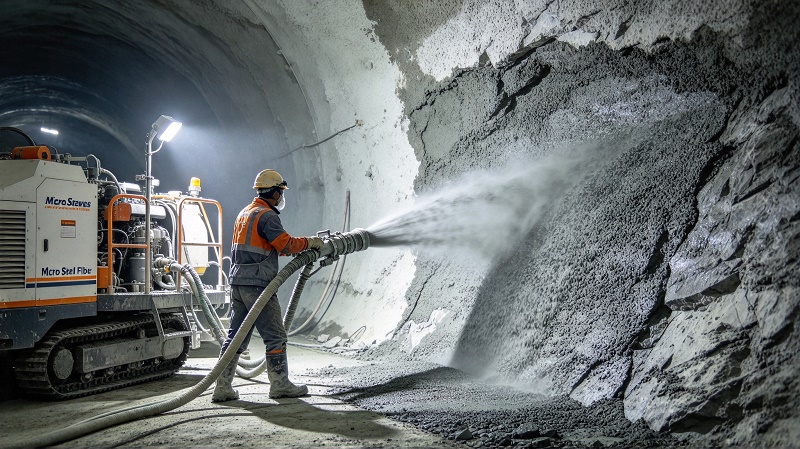
Ultra-High Performance Concrete (UHPC) and decorative concrete sit at opposite ends of the construction spectrum. One is engineered for extreme structural demands—thin bridge decks, slender columns, impact-resistant facades. The other is judged by what the eye can see: color uniformity, surface texture, and the absence of blemishes. Yet both applications share a critical material dependency: micro steel fiber with high tensile strength and copper coating. Specifying the wrong fiber can mean compromised ductility in UHPC or rust-stained surfaces in decorative work. This guide explains why tensile strength and copper coating are not optional upgrades—they are baseline requirements for these two demanding applications.
Key Takeaways
| Requirement | Why UHPC Needs It | Why Decorative Concrete Needs It |
|---|---|---|
| Tensile strength ≥ 2,850 MPa | Bridges cracks without snapping under extreme flexural load | Resists pull-out during finishing, reducing protrusion risk |
| Copper coating | Enhances bond with dense UHPC matrix; protects fiber during storage and mixing | Minimizes rust staining if a fiber reaches the surface |
| Diameter ~0.2 mm | Disperses uniformly in a low-water, high-packing matrix | Small profile is less disruptive to fine surface finishes |
| Length ~13 mm | Balances anchorage with workability at high dosage | Short enough to limit “hairy” surface exposure |
Why UHPC Demands High-Tensile Micro Steel Fiber
UHPC achieves compressive strengths exceeding 150 MPa, but compression is only half the story. Its defining advantage—tensile ductility—comes almost entirely from micro steel fiber bridging cracks after the matrix has cracked. Without adequate fiber strength, UHPC behaves like a very strong but brittle material.
The 2,850 MPa threshold
Standard steel fibers may reach 1,100–2,000 MPa. UHPC-grade micro steel fiber is expected to deliver ≥ 2,850 MPa tensile strength. At this level, the fiber can sustain the high local stresses transferred across a crack in an ultra-dense matrix without premature rupture. When a crack opens, the fiber must carry the entire tensile load at that location. A lower-strength fiber may simply snap, converting a ductile failure mode into a brittle one—precisely what UHPC design seeks to avoid.-1
The dosage reality
UHPC is not reinforced with a token addition of fiber. Typical dosages range from 150 to 314 kg/m³, roughly 2–4% by volume. At this concentration, fiber quality is magnified. A batch containing substandard fiber does not merely underperform—it can compromise the entire element‘s post-crack integrity.-15
The Critical Role of Copper Coating
Copper coating is sometimes misunderstood as a cosmetic feature. In UHPC and decorative concrete, it performs two engineering functions that directly affect project outcomes.
Bond enhancement in a dense matrix
UHPC’s low water-to-binder ratio and high packing density create a matrix that is difficult for any reinforcement to grip. The copper layer improves the chemical and mechanical interaction between the micro steel fiber and the cementitious paste, promoting stronger interfacial bonding and more efficient crack-bridging. Without this bond, a high-tensile fiber cannot mobilize its strength—it simply pulls out before yielding.-15
Corrosion protection before and after casting
Copper coating protects the steel core during storage, transport, and mixing, preserving surface activity so the fiber bonds rather than oxidizes. This matters even more in decorative concrete. In hand-finished or shallow-stamped work, fibers near the surface can be exposed to atmosphere and moisture. Uncoated steel fibers in this position can rust, leaving staining that undermines the decorative intent. A copper-coated micro steel fiber does not make exposure desirable, but it substantially reduces the risk of rust blooming at the surface if a fiber sits close to the finish plane.-20
Why Decorative Concrete Projects Cannot Ignore Fiber Specification
Decorative concrete contractors often avoid steel fibers altogether because of finishing risks. That caution is reasonable—but it points to the solution, not the problem. The answer is not to abandon micro steel fiber, but to specify a grade that is compatible with decorative finishing when reinforcement is required.
Surface exposure and rust staining
Deep stamping, exposed-aggregate finishes, and aggressive hand troweling can pull fibers to the surface. If those fibers are uncoated carbon steel, moisture exposure can produce rust spots within weeks. Copper-coated micro steel fiber at a fine diameter (typically 0.2 mm) presents a much smaller visual signature and a far lower corrosion risk if a fiber reaches the surface. The coating does not guarantee invisibility, but it changes the consequence of incidental exposure from a staining liability to a manageable detail.
Finishing compatibility
Fine micro steel fiber(13 mm length, ~0.2 mm diameter) disperses more uniformly and is less likely to create the “hairy” surface associated with larger macro fibers. Combined with proper screeding and finishing timing, this allows decorative contractors to retain crack-control benefits without sacrificing surface quality. The fiber is not the enemy of decorative work—poorly specified fiber is.
What to Look for in a Micro Steel Fiber Supplier
For projects spanning UHPC and decorative concrete, a supplier should demonstrate:
Consistent tensile strength verified batch by batch, with a declared minimum at or above 2,850 MPa for UHPC-grade product
Uniform copper coating that is metallurgically bonded, not merely painted or flashed
Tight dimensional control on diameter and length, because dispersion and surface behavior depend on consistency
Documented compliance with ASTM A820 and EN 14889-1, supported by third-party test reports
Application experience in both UHPC precast and architectural concrete, not just industrial flooring
A micro steel fiber that performs in a warehouse slab may not perform in a 20 mm-thick UHPC facade panel. The supplier must understand the difference.
FAQ
Q: Can I use standard steel fiber instead of 2,850 MPa micro steel fiber in UHPC?
A: No. UHPC’s crack-bridging mechanism relies on fiber strength exceeding the local stress at the crack plane. Lower-strength fiber may rupture before mobilizing ductility, producing brittle behavior.
Q: Does copper coating completely prevent rust in decorative concrete?
A: It significantly reduces the risk and severity of rust staining if a fiber reaches the surface, but it is not a substitute for good finishing practice. Fibers should still be kept below the finish plane wherever possible.
Q: What dosage of micro steel fiber is typical for UHPC?
A: UHPC dosages commonly fall between 150 and 314 kg/m³ (roughly 2–4% by volume). The exact dosage is determined by the mix design and performance testing.-15
Q: Is copper-coated micro steel fiber suitable for stamped concrete?
A: It is more suitable than uncoated fiber because incidental surface exposure is less likely to cause rust staining. However, deep relief stamping increases exposure risk; shallow stencil or broom finishes are safer when fiber reinforcement is required.
Conclusion: Specify with Confidence—and a Supplier You Can Trust
UHPC and decorative concrete place opposite demands on micro steel fiber: one demands extreme tensile performance at high dosage, the other demands surface compatibility and corrosion control at the finish plane. High tensile strength (≥ 2,850 MPa) and copper coating are the two specifications that allow a single fiber technology to serve both worlds. When you are ready to source micro steel fiber that meets these standards—backed by documented certification and application experience—choose Daye, a steel fiber manufacturer committed to delivering UHPC-grade and decoration-compatible fiber with the consistency your projects require.